Choosing between production inkjet printers and laser printers is no longer a simple speed-versus-quality debate. Advances in inkjet printing technology—from high-efficiency printheads to new water-based and UV inkjet formulations—have pushed inkjet into applications that used to be laser-only territory. Meanwhile, laser continues to shine in crisp text, predictable workflows, and consistent output for transactional and office-adjacent work. This guide breaks down how each technology performs in real-world, high volume printing scenarios so you can confidently align your next investment to business goals.
Production inkjet devices (often called an inkjet press) jet microscopic droplets of ink directly onto substrates. In production environments, they run continuous feed (web) or sheetfed, delivering rapid throughput with inline finishing and variable-data capability. Modern industrial inkjet printers support coated and uncoated papers—and with primers or optimized inks, synthetics and specialty stocks.
Laser engines use electro-photographic (EP) imaging to attract toner to a drum, transfer it to paper, and fuse it with heat and pressure. At production scale, laser (toner) presses are valued for sharp text, fine line work, and reliable registration across a wide range of office and transactional documents, book blocks, and marketing collateral.
Industrial inkjet platforms are designed for uptime: scalable duty cycles, automated head maintenance, and integration with bindery/finishing lines. They excel in:
Personalization & variable content at full engine speed
Transactional & transpromo statements combining data and graphics
Books and manuals with short runs or on-demand models
Direct mail with versioning, barcodes, and dynamic imagery
Nano Mark's NM800 continuous inkjet printer is capable of printing up to 5 lines at a maximum speed of 7.5 m/s while maintaining excellent print quality. This continuous coding technology is particularly suitable for the high-speed production lines required by industries such as food, beverage, pharmaceutical, cosmetics and electronics.
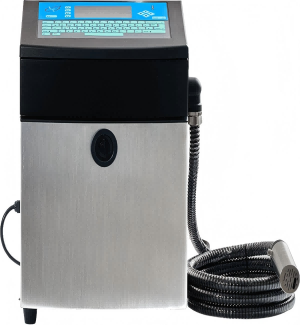
Today’s production inkjet achieves sustained speeds measured in hundreds of feet per minute (continuous feed) or thousands of sheets per hour (sheetfed). Crucially, it maintains that velocity even when printing heavy coverage and variable data—ideal for SLAs and tight turnaround windows.
While aqueous dominates commercial production inkjet, UV inkjet printers open doors to:
Non-porous materials (films, plastics, labels, packaging)
Instant curing, reducing turnaround and enabling post-process handling
High optical density and abrasion resistance for durable applications
Laser (toner) presses continue to win where ultra-sharp text, line art, and micro-fine detail are critical. Typical strengths include:
Predictable color on a wide stock range without priming
Tight registration and excellent small-point legibility
Mature workflows with broad operator familiarity and established service ecosystems
Production inkjet often achieves higher raw engine speed, especially in continuous-feed configurations, and keeps that speed with full-coverage variable data. Minimal warm-up and fewer stops for long jobs improve end-to-end efficiency.
Laser devices may have slightly longer warm-up/fusing cycles and can slow with heavy coverage or certain media, but they’re highly efficient for mixed office/production fleets and short-to-mid runs with frequent job changes.
Inkjet consumables: Cost is driven by coverage, ink set (dye vs pigment), and any pre-/post-coating. On uncoated or “inkjet-treated” stocks, cost per page can undercut toner—especially for heavy coverage and color-rich variable jobs.
Laser consumables: Toner, drums, and fusers are predictable and widely available. For tight, text-heavy work on standard stocks, toner remains cost-competitive.
Media: Inkjet may prefer optimized papers or primers for best color/latency; laser runs broadly across commodity and specialty stocks without pretreatment (though heat sensitivity of some substrates can be a limit).
Inkjet: Modern heads produce smooth gradients, photographic images, and brand color solids with impressive consistency. On treated/coated stocks, color vibrancy rivals toner; pigment sets improve water/ozone resistance. Fine 3–5pt text is now very good, though the absolute crispness of hairlines may still favor toner in some cases.
Laser: Toner’s electro-photographic process yields razor-sharp text and vector edges, excellent for forms, financial statements, barcodes, and line diagrams. High-coverage photo work is strong, though some glossy “toner sheen” can appear on certain stocks.
| Attribute | Production Inkjet Printers | Laser Printers |
|---|---|---|
| Engine Type | Drop-on-demand inkjet (digital inkjet printing) | Electro-photographic toner |
| Best For | High volume printing, variable data, books, direct mail | Text-centric jobs, forms, transactional, office-adjacent |
| Speed at Coverage | Maintains speed with heavy, variable coverage | Can reduce speed with heavy coverage on some media |
| Text & Line Sharpness | Excellent; near-toner on treated/coated stocks | Benchmark-level crispness |
| Color & Images | Smooth gradients; saturated solids on optimized media | Strong color; occasional toner gloss on some stocks |
| Media Flexibility | Broad and growing; UV inkjet printers expand to non-porous | Broad stock latitude; heat-sensitive media may be limited |
| Warm-Up/Throughput | Rapid start; efficient for long runs | Slightly longer warm-up; efficient for mixed/short runs |
| Variable Data | Native strength at full speed | Strong, but complex VDP can constrain throughput |
Total Cost of Ownership (TCO) depends on your application mix:
Inkjet TCO advantages
Lower cost per page on long, color-heavy runs and VDP
Reduced click-based pricing variability (where applicable)
Potential savings from consolidating preprinted shells (print full color on white)
Laser TCO advantages
Predictable consumables and service costs
Strong economics for text-heavy, monochrome or light-coverage color work
Simplified media handling without primers/coatings
Analysis shows that while production-grade inkjet printers require a higher initial investment, they offer significant operational cost advantages. Laser marking systems cost approximately $0.02 per mark, while ink-based systems cost $0.07-$0.09. In high-volume production environments, this cost difference can quickly justify the investment. Most users expect to recoup their inkjet printer investment within 36 months, rather than waiting seven years.
Inkjet: Automated head cleaning, nozzle compensation, and inline quality checks reduce manual interventions. Operators should monitor humidity, paper conditioning, and (when applicable) primers and dryers/IR units.
Laser: Routine drum/fuser/roller maintenance is well understood. Operators benefit from established diagnostics and plentiful service partners.
Direct mail with micro-segmentation and image personalization
On-demand books/manuals with dynamic imposition
Catalogs, brochures, and transpromo blending data and graphics
Labels, packaging, and synthetics—especially with UV inkjet systems
Laser Printers
Statements, bills, and regulatory documents with small text
Secure MICR checks (specialized toner), forms, and barcodes
Short-run office-to-production crossover jobs requiring consistent output
Ask three questions:
What’s my typical page? If coverage is moderate-to-heavy color with personalization, go production inkjet. If it’s mostly black text or light-coverage color with fine lines, laser is a safe win.
How do I run jobs? Long runs, tight SLAs, and heavy VDP favor inkjet. Mixed short runs and text-centric workstreams fit laser.
What media do I need? Non-porous or specialty stocks might push you toward UV inkjet; broad commodity papers still play well with laser.
Choosing the right printing technology requires a comprehensive consideration of specific application requirements, budget constraints, and long-term operational goals. Production-grade inkjet printers clearly offer advantages for high-volume production environments, applications requiring multi-material adaptability, or those with stringent environmental requirements.
Studies have shown that print service providers equipped with production-grade inkjet equipment have achieved an average 9% reduction in paper costs/consumption, a 9% reduction in production waste, an 8% increase in profits, and a reduction in the number of press operators by one.
The printing industry is undergoing significant change, with digital transformation and automation emerging as key trends. The global digital printing market is projected to reach $34.3 billion by 2025, growing at a compound annual growth rate of 6.7%. Production-grade inkjet technology, a key driver of this transformation, is projected to grow at a rate of 12.1%, far exceeding the 4.2% growth rate for laser printing.
Sustainability requirements are reshaping the printing technology landscape. Epson announced it will discontinue laser printer production by the end of 2026 and transition to more environmentally friendly inkjet technology, projecting annual energy savings of 2,240 GWh, equivalent to a reduction of 1.3 million metric tons of CO2 emissions. This trend reflects the industry's growing emphasis on environmentally friendly solutions.
Artificial intelligence and data-driven insights are emerging as the new frontier of innovation in printing technology. 84% of organizations plan to increase AI spending, and 73% plan to simultaneously upgrade their printing infrastructure. Emerging use cases for AI in cybersecurity, service innovation, intelligent document processing, analytics, and sustainability will drive printing technology towards smarter and more efficient outcomes.
Future printing technology competition will no longer focus solely on speed and quality, but will instead consider environmental impact, energy efficiency, material diversity, and intelligence. Under this trend, production-level inkjet printers are winning the technological competition with their technological advantages and development potential.
Contact: Jason
Phone: +8613337336942
E-mail: [email protected]
Add: Hangzhou City, Zhejiang Province, China