When I started analysing Nano Mark’s laser marking systems, I quickly saw choosing between UV and fiber lasers for plastic closures isn’t easy. Both technologies have their place—you need to dive into science, material properties, and real-world production demands to pick right one. After working with countless customers and seeing results firsthand, I want to tell you what I’ve learned about this choice.
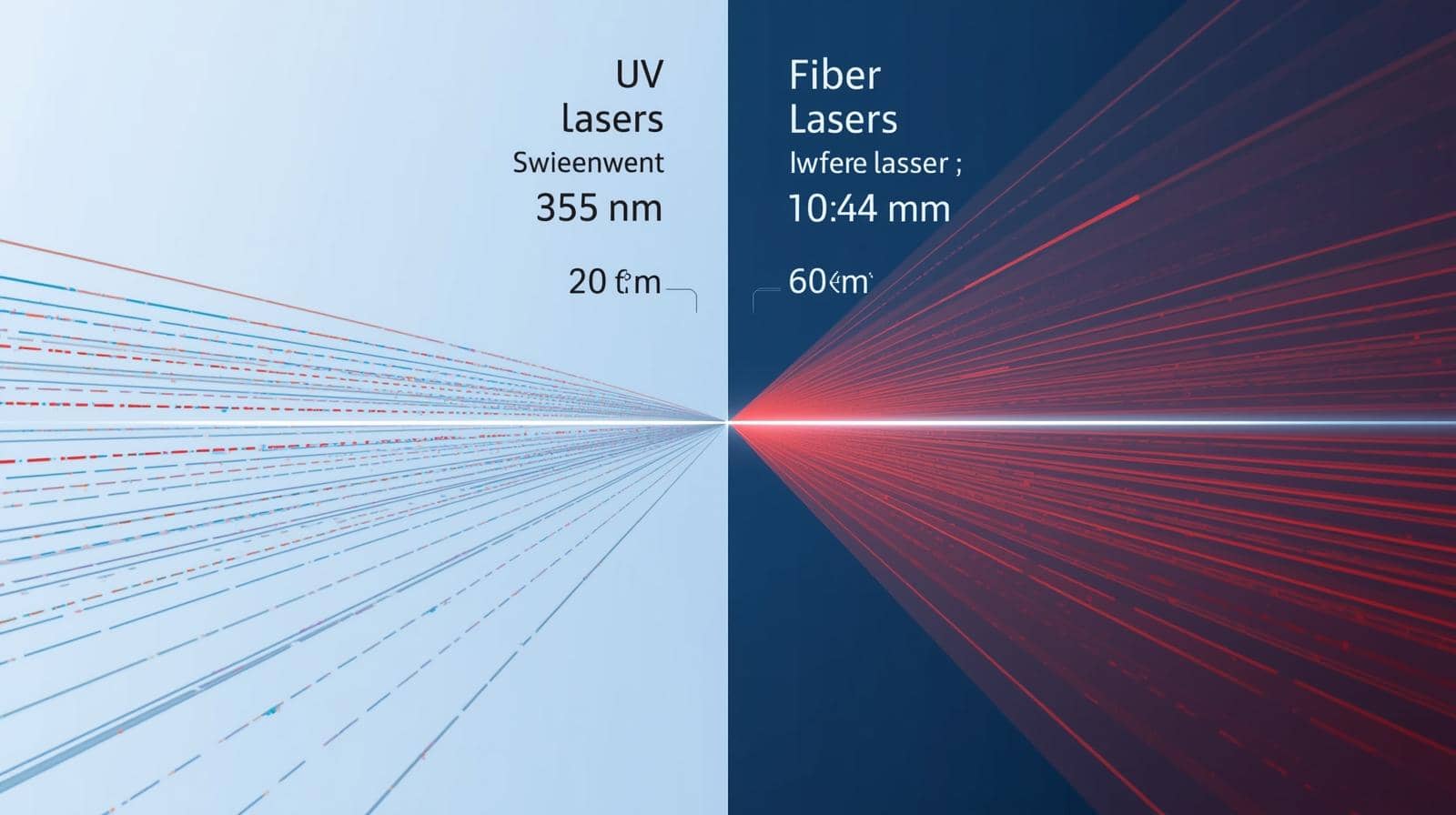
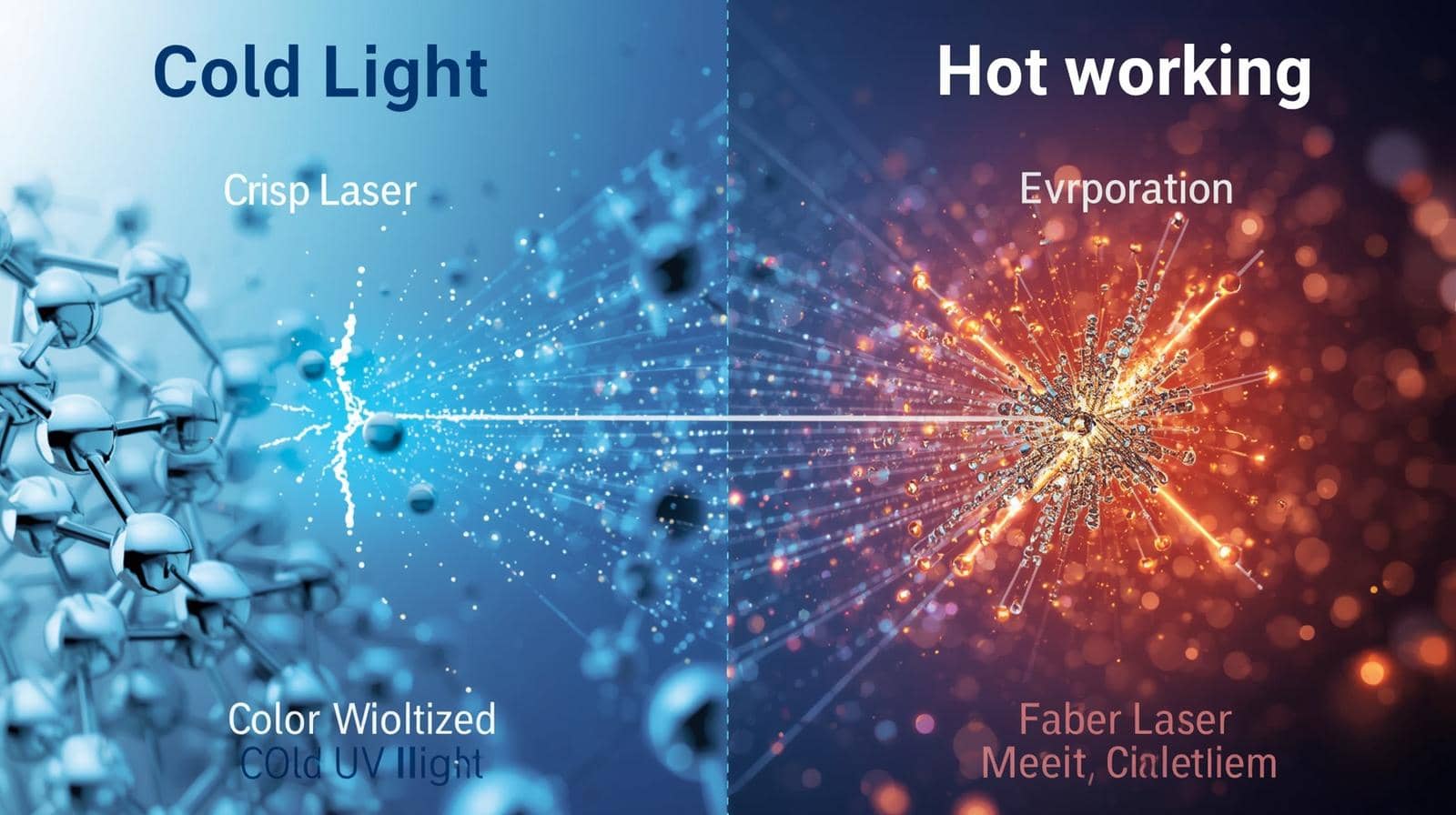
Let’s start with what makes UV Laser technology different from fiber lasers. Our Nano Mark UV Laser systems run on 355-nanometer wavelength—this is on ultraviolet spectrum. What makes this technology revolutionary? UV Lasers don’t use heat to make permanent marks. Instead, they use photolysis—an fancy way of saying they break material’s molecular bonds directly, no significant thermal stress.
I often describe this to customers as “surgical precision.” Wavelength is short—about one-third of our fiber laser’s 1064nm. Because wavelength is short, laser can focus to 20-micrometer spot size—this lets it make precise marks in tight spaces.
Energy density of UV photons is high—they can cut molecular bonds without heat fiber lasers need. This is “cold marking”—it’s changed the game for heat-sensitive materials.
Our Nano Mark fiber laser systems—like NF720i, NF730i, NF750i—work very differently. They emit 1064nm light and use thermal processing. When fiber laser beam hits material surface, it generates intense heat—this either evaporates surface to expose underlying material, causes chemical color change, or creates controlled carbonization.
I’ve watched these machines on production lines—they’re impressive. Fiber lasers are fast, efficient—why they’ve dominated industrial marking for decades. Power scaling is great—we offer up to 50 watts. Beam quality is excellent for crisp, durable marks on hard materials.
Spot size for fiber lasers is larger—about 60 micrometers. What they lack in finesse, they make up for in raw marking capability and speed.
High-density polyethylene (HDPE) is top pick for pharmaceutical packaging—it has great chemical resistance, rigidity, and works well with drugs. But marking HDPE has always been a challenge. When you use heat-based fiber lasers on thin-walled HDPE containers, you risk thermal damage—material can become brittle, discolored, or develop micro-cracks that compromise closure integrity.
This is where our UV Laser technology changed the game. Because UV Lasers don’t use heat, they make marks without any thermal stress. I’ve supervised countless production runs where customers switched from fiber lasers to our NN-UV803i, NN-UV805i, or NN-UV810i models—improvement was immediate. Marks are crisp, high-contrast—most importantly, no thermal damage to material.
Pharmaceutical industry demands this. Regulatory bodies require closures to maintain integrity and performance. UV marking lets customers mark HDPE bottles with lot codes, expiration dates, and barcodes while keeping 100% material integrity.
Here’s what excited me most: UV Lasers can make high-contrast marks on HDPE without laser additives. Let me explain why this matters.
For years, manufacturers marking polyolefins had to add laser-sensitive additives to plastic formulations. These additives absorb laser energy and help create readable marks. On HDPE, fiber laser systems still need these additives—this adds cost and requires reformulating plastic compound.
Our UV systems break this paradigm. Direct photolysis process can create dark, long-lasting, high-resolution codes on light-colored HDPE backgrounds without any additional additives. This means customers can use standard HDPE formulations without expensive modifications. For a pharmaceutical company producing millions of units annually, this translates to big cost savings.
Polypropylene (PP) is more complicated than HDPE—I want to be transparent about this because it affects which laser technology wins for PP applications.
PP needs different handling than HDPE—its molecular structure and thermal properties are different. PP doesn’t mark as easily with fiber lasers as HDPE does. Key issue: Traditional fiber laser systems struggle to make consistent, high-contrast marks on natural-color PP without laser additives.
This is where many manufacturers get stuck. They have to either add laser-sensitive additives to PP formulation or accept lower marking quality. For beverage closures and other commodity applications, this might work. But for pharmaceutical and medical device closures, consistency and quality are non-negotiable.
In production, I’ve seen UV Lasers handle PP better than fiber lasers—even here. While PP still benefits from properly formulated laser-sensitive additives, UV wavelength interacts with material in way that produces better results than fiber lasers, even with additives.
Cold marking process doesn’t create thermal damage that causes inconsistent marks on PP. Molecular bonds are severed by photons, not heat-induced processes. This means cleaner, more precise marks with less variation between parts.
But—I want to emphasize this because honesty matters—if you’re producing high-volume PP closures with optimized laser-sensitive additives, well-tuned fiber laser systems can still deliver strong results. Key difference: UV systems provide more consistent results across varying material conditions without needing as much additive formulation optimization.
Let’s break down performance factors that matter to closure makers:
On HDPE: UV Laser wins hands down. Marks are crisp, consistent—no additives needed.
On PP: UV Laser still has advantage, but well-optimized fiber laser system with additives is competitive.
UV Laser: Minimal to none. This is one of its core advantages.
Fiber laser: Some risk. Modern systems minimize this, but it’s still there.
Fiber laser: Our systems hit up to 30 characters per second. Speed win: Fiber.
UV Laser: Also up to 30 characters per second. No difference.
Fiber laser: Average 100,000-hour lifespan, air-cooled, little maintenance.
UV Laser: 15,000-hour average lifespan, water-cooled, needs regular water system maintenance.
Fiber laser: Usually lower initial cost.
UV Laser: Higher initial investment, but offset by reduced material costs when additive-free marking is possible.
If you make pharmaceutical HDPE closures, I’d recommend UV Laser systems. Regulatory compliance is easier to achieve. Material integrity is guaranteed. You save money on laser additives. Our customers in this space always report higher satisfaction with UV-marked closures.
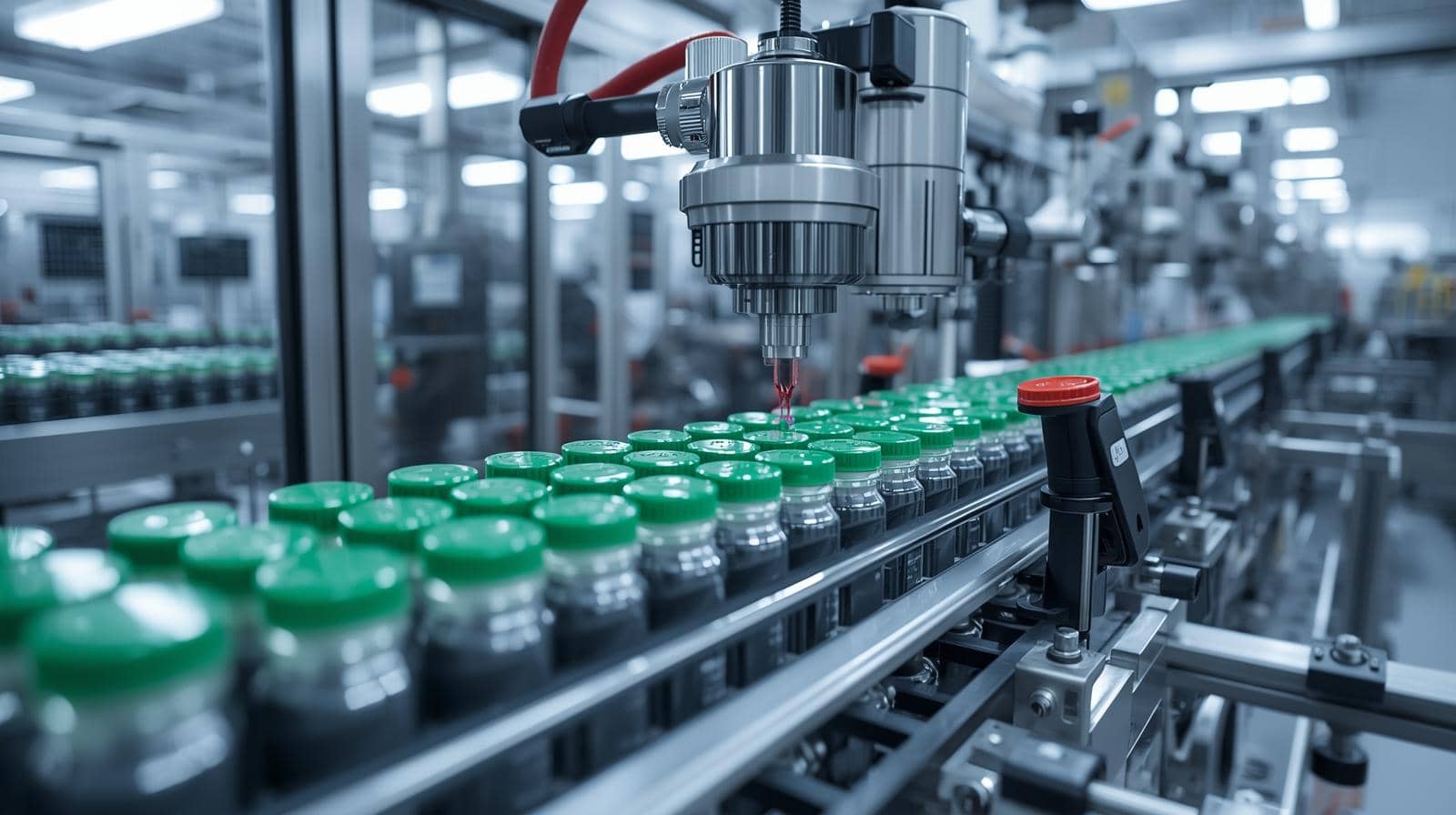
For beverage closures on PP, either technology can work. But here’s my honest take: If your closures have standard laser additives, fiber laser system will deliver good results cost-effectively. If you want premium quality without additive optimization, UV technology gives you insurance against quality inconsistency.
Both technologies reach same speed—30 characters per second. Decision depends on material and cost, not line speed.
After years using both technologies, here’s what I tell customers:
Choose UV Laser if:
You mark HDPE and want no thermal damage
You want to eliminate laser additives from HDPE formulation
Material integrity is your top priority
You produce pharmaceutical, medical, or high-end cosmetic closures
Choose fiber laser if:
You use well-formulated PP with laser additives
Your main concern is capital equipment cost
You need 100,000-hour equipment lifespan without water cooling
You produce high-volume commodity closures
Choose hybrid capability if:
You need flexibility to handle multiple material types and formulations
For HDPE and PP closures in 2025, UV Laser wins on technical merit—especially for pharmaceutical and medical applications. But—this is important—fiber lasers remain solid, cost-effective choice for high-volume, properly formulated plastic closures.
Real winner isn’t a laser type—it’s choosing right technology for your material, production volume, and quality needs. At Nano Mark, we’ve built our reputation by helping customers make this decision. We offer both technologies because we know one size doesn’t fit all.
When you’re ready to evaluate these systems for your closure marking needs, reach out to our team at Nano Mark. We offer testing and demonstrations because we believe you should see results yourself before making this investment.
Related Resources:
Nano Mark UV Laser Product Page: https://codingmachine.net/product/uv-laser.html
Nano Mark Fiber Laser Product Page: https://codingmachine.net/product/fiber-laser-marking-machine.html
Laser Marking Systems Overview: https://codingmachine.net/new/laser-marking-system.html
Contact: Jason
Phone: +8613337336942
E-mail: [email protected]
Add: Hangzhou City, Zhejiang Province, China