I walked into a grocery store not long ago and saw something that made me stop mid-aisle.
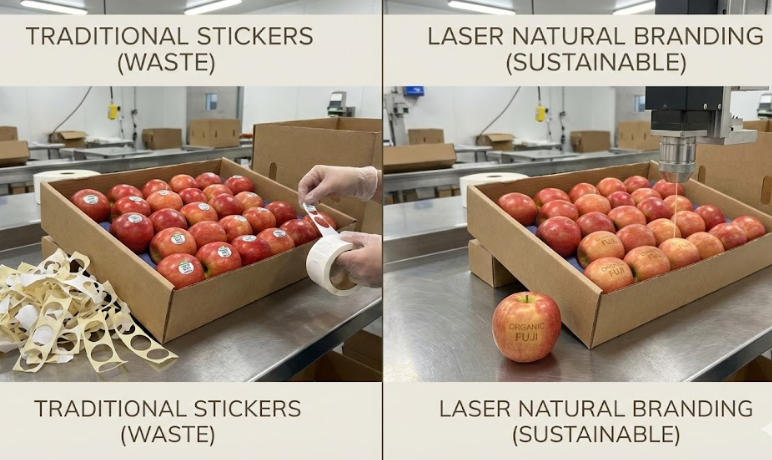
Avocados. With little laser-etched Easter characters on the skin. No sticker anywhere.
That’s not a “cute marketing idea.”
That’s a signal.
Retailers don’t wake up and say, “Let’s do lasers because it looks cool.”
They do it because stickers bring baggage—label rolls, backing paper waste, changeovers, and the constant “we’re out of the right sticker again” chaos.
Some sticker-free systems pitch the opposite: no label applicator, zero label cost, and zero consumables tied to the marking itself.
And once a retailer tastes that kind of simplicity, they start asking suppliers hard questions.
Questions like:
“Why are we still paying for stickers at all?”
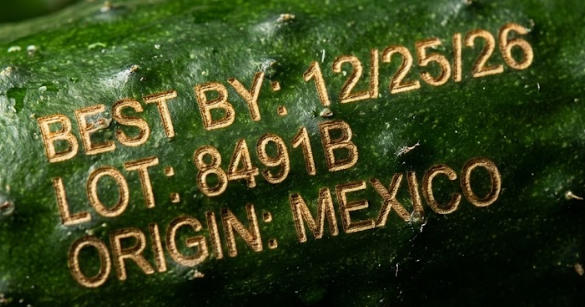
People call it “natural branding,” which sounds like a wellness trend, but it’s a practical process.
One common approach uses a laser to remove color from the outer layer of the fruit or vegetable skin—basically a controlled surface change that leaves a visible mark.
The better explainers don’t hide the mechanics: the system depigments the uppermost cell layer and removes the outermost skin layer while aiming to keep the fruit intact underneath.
That detail matters because every buyer eventually asks the same thing.
“Okay… but does it mess up the produce?”
If you sell produce, you know the fear.
A tiny change in skin condition can turn into shrink, complaints, or a retailer delisting you.
What’s interesting is that across the industry, the consistent claim is this: when done correctly, laser marking only affects the outermost layer and does not materially impact shelf life.
That doesn’t replace your own trials.
But it does tell you where the industry conversation sits right now.
And it frames your next move as a brand owner or importer:
don’t argue about it in meetings—test it.
Here’s where buyers get serious.
Because a laser that looks great on one cucumber in a lab means nothing if your grading line runs like a freight train.
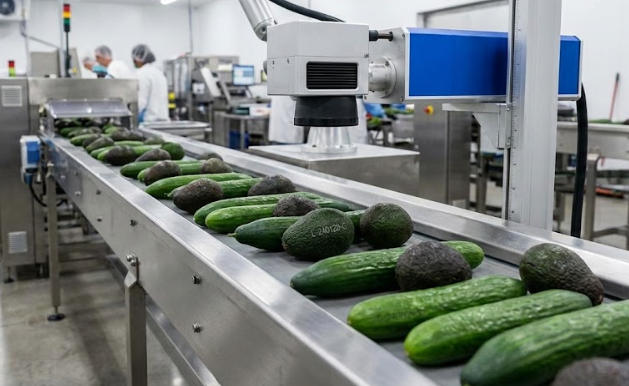
Many sticker-free produce systems are designed for “on-the-fly” marking—items keep moving on a conveyor instead of stopping for each mark.
Some also rely on fast vision systems, such as 3D cameras, to detect position and orientation, then send that data to the laser in milliseconds.
At higher throughputs, suppliers may integrate multiple lasers into a single machine to reduce marking time per item.
This is the kind of detail procurement teams care about, because it turns “innovation” into a realistic capacity plan.
Yes, reducing sticker waste matters.
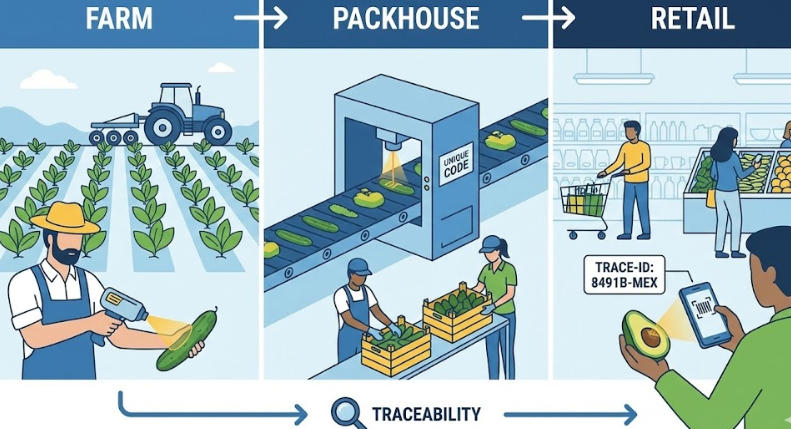
But the bigger story is control over identity and traceability.
Laser systems can mark logos, certification symbols, text, and even 2D codes such as DataMatrix or QR.
That opens the door to SKU-level identification and tighter digital traceability.
Fewer mystery items in mixed lots.
Fewer human errors when labels change mid-season.
And if you run seasonal promotions, laser marking starts to look less like a sustainability gesture and more like a flexible operational tool.
Sticker-free thinking doesn’t stop at fruit skin.
Food manufacturers are also experimenting with laser coding directly on packaging films, including compostable films, to produce clean, permanent codes without adding extra materials.
The signal is consistent across categories:
less material, fewer consumables, fewer failure points.
Produce just happens to be the most visible battlefield.
If you’re mapping options, it helps to understand the laser families and where they typically fit.
CO₂ lasers are commonly used for organic surface marking applications—fruits, vegetables, eggshells, and certain bakery products.
If you want neutral orientation material rather than a sales deck, these two internal pages are useful starting points:
CO₂ laser printer overview (coding and marking applications)
Laser marking systems guide (fiber vs CO₂ vs UV, and typical use cases)
Macsa shares a cucumber example with real-world parameters (like 1.3 seconds per mark).
Try to Use Nano Mark to build an internal shortlist and a realistic trial plan.
If we were sitting down with a vendor this week, I’d ask:
“Show me marks on my SKUs—different ripeness levels, different skin textures.”
“What line speed can you hit without slowing us down?”
“Do you rely on vision systems for positioning, or do we need perfect placement upstream?”
“If the mark looks weak, do we adjust software on the fly or stop the line?”
“Can you mark a simple logo today and a scannable 2D code next quarter?”
You don’t need a hundred questions.
You need the right five.
Sticker-free produce isn’t a future concept.
It’s already on real retail shelves.
The real question is whether your supply chain wants to lead the trial—or get pulled into it after a retailer makes it the new standard.
If you’re considering it, start small:
pick one hardy vegetable or fruit, define what “good” looks like, and run a tight test.
Then scale like you mean it.
It signals retailer pressure to reduce labeling waste and consumables while improving item-level identification.
This impacts traceability design, promotional flexibility, and long-term labeling costs.
Results depend on produce type, ripeness, surface conditions, and laser settings.
Buyers should confirm performance through shelf-life, appearance, and readability trials under real cold-chain conditions.
Produce with more robust skins and clear depigmentation contrast is generally more suitable.
Most suppliers recommend starting with a limited SKU pilot before scaling.
Yes, depending on marking time, line speed, and positioning method.
Some systems use vision guidance and multiple lasers to maintain continuous, on-the-fly operation.
Depending on system capability, text, logos, and 2D codes such as QR or DataMatrix can be marked.
Scan contrast and minimum module size should be validated during trials.
ROI should compare equipment and integration costs against ongoing label spend, changeovers, labor, waste, and misidentification risk.
Contact: Jason
Phone: +8613337336942
E-mail: [email protected]
Add: Hangzhou City, Zhejiang Province, China