A laser marking machine is sold on low upkeep: no ink to flush, no solvent smell, no nozzle to unblock. That claim is true and it is also where buyers get careless. A laser marker trades consumable ink for precision optics, a sealed laser source with a finite rated life, and a cooling loop that decides how much of that life you actually receive. The machine rarely fails loudly. The mark slowly softens, the lens collects spatter, the tube drifts toward replacement, and the plant treats a maintenance item as a machine failure. This guide sets out the six rules that keep a laser coding line marking like the day it was commissioned.
Key takeaways:
The lens is a consumable, not a component. A zinc selenide focusing lens for a 10.6 micron CO2 source degrades with spatter and dust, and it is the cheapest place to spend maintenance attention.
Tube life is a planning number. Sealed CO2 sources are rated for roughly 40,000 hours, fiber sources carry a mean time between failures near 100,000 hours, and UV tubes sit near 15,000 hours. Put the rating on the production calendar, not in a drawer.
Cooling discipline buys tube hours. UV sources run water cooled, fiber and CO2 run air cooled, and both punish neglect the same way: heat kills the source early.
Focus drift breaks marks quietly. A working distance measured in millimeters means fixture wear shows up as soft marks long before anything looks broken.
Test marks on real material catch problems early. A daily sample marked on the actual production material is the cheapest diagnostic instrument in the building.
Honesty cuts both ways, so start with the side that favors the laser. An inkjet coder has a fluid path, and fluid paths demand ritual: flush at shutdown, flush at startup after a weekend, monitor viscosity, replace filters on schedule. A laser marker has none of that. There is no ink to dry, no line to clean, no make-up fluid, and shutdown means switching off.
For plants running occasional weekend stoppages or seasonal campaigns, this is a genuine advantage. A CO2 coder that sits idle for three weeks does not need a recovery procedure before it marks again, which is exactly the situation where an inkjet line earns its reputation for Monday morning trouble.
What remains after the fluid path is gone is shorter in daily minutes but less forgiving in consequences: an optical path, a heat sensitive source, and mechanics that hold millimeter scale alignment. The six rules below cover that remainder.
The focusing lens sits in the optical path immediately before the beam reaches the work, which makes it the component nearest to the spatter, fumes and dust that marking produces. On a CO2 source the lens is zinc selenide, and the same properties that make the material transparent at the 10.6 micron wavelength make it delicate: it cannot be scrubbed like a window, and a spatter blob burned into the surface cannot be cleaned off at all.
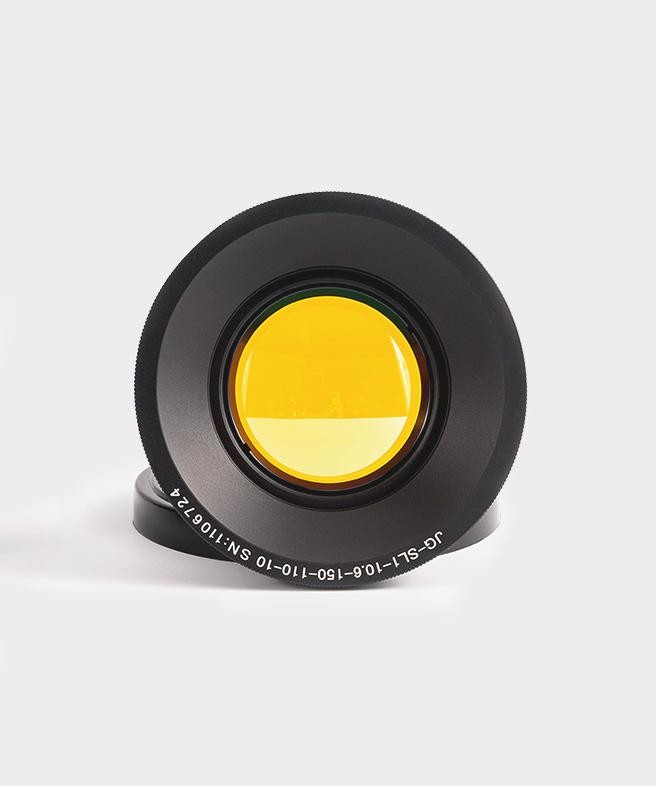
A CO2 focusing lens assembly. The part number encodes the 10.6 micron wavelength it is ground and coated for, which is why spares are ordered by full part number.
Prevention beats cleaning, so the sequence matters:
| Lens care action | Why it protects the mark |
|---|---|
| Inspect on a fixed schedule, weekly in dusty plants | Spatter and film build up gradually and soften the beam before anyone notices |
| Blow loose dust off with clean dry air first | Wiping a dusty lens drags particles across the coating and scratches it |
| Wipe only with optics grade wipes and the specified solvent | Zinc selenide coatings survive only the manufacturer approved cleaning kit |
| Never touch the surface with bare fingers | Skin oils burn permanently into the coating under beam load |
| Keep a spare lens on the shelf | A damaged lens turns into an unplanned line stop unless a replacement is in the cabinet |
Lens part numbers encode their purpose: a lens assembly stamped for a 10.6 micron wavelength belongs on a CO2 source and nowhere else. When ordering spares, match the full part number from the assembly rather than describing the lens, because diameter, coating and focal behavior all hide inside that string.
A lens budgeted as a routine consumable, replaced on condition rather than on failure, is the single highest return maintenance item on a laser marker.
The laser source is sealed, and a sealed source does not last forever. What separates a planned replacement from an emergency is whether the rating was ever written on the calendar. The three common source types span an order of magnitude:
| Source type | Typical rated life | Cooling | Notes for planning |
|---|---|---|---|
| Sealed CO2, RF excited | Roughly 40,000 hours | Air | Workhorse for organics, coatings and some plastics |
| Fiber | Near 100,000 hours MTBF | Air | Longest lived, suited to metals and hard plastics |
| UV, frequency tripled | Near 15,000 hours | Water | Shortest life, gentlest mark, plan the replacement |
Translate the hours into your own shift pattern before anything else. A source rated near 40,000 hours runs roughly six years of single shift weekdays, but under three years of continuous three shift operation, and the same arithmetic applies to every row of the table. A UV tube near 15,000 hours is a mid life budget item for a two shift line, not a distant worry.
Two planning habits follow. Ask the supplier to state, in writing, whether the rating is calendar limited as well as hour limited, because sealed sources age slightly even when idle. And when a line approaches two thirds of rated life, put the replacement conversation on the schedule, since lead times on sources are measured in weeks, not days.
Every laser source converts electricity to light imperfectly, and the leftover heat has to leave the machine. How it leaves depends on the source type: fiber and CO2 markers run air cooled with filtered fans and vents, while UV sources run water cooled with a circulating loop.
Air cooled machines fail in a boring way: dust mats the filter, airflow drops, internal temperature climbs, and the source ages faster than its rating. The countermeasure is on the same schedule as every other filter in the plant. Check and replace intake filters on the maintenance calendar, keep vent openings clear even when the area gets crowded with pallets, and treat any new fan noise as a finding rather than a nuisance.
Water cooled machines fail in a more expensive way, so the checks are stricter. The loop fluid is a specified consumable with a change interval, not tap water topped up when convenient. Fluid level, fluid condition and pump operation belong on a weekly walkthrough card, and any visible debris or cloudiness in the reservoir is a stop and investigate item, because the loop cools an optical assembly that costs real money.
Cooling and environment are the same conversation, because the specification window for laser markers runs 5 to 45 degrees Celsius and 10 to 90 percent relative humidity, and three environmental factors dominate reliability:
| Factor | What goes wrong | The habit that prevents it |
|---|---|---|
| Ambient heat | Source and electronics age faster above the window | Site the machine out of direct process heat, verify the window holds at the marking point |
| Dust and marking fumes | Lens contamination, clogged cooling filters | Extraction at the marking point, weekly lens inspection in dusty areas |
| Humidity and condensation | Optical damage and electronics corrosion | Avoid cold corners where condensation forms, keep within the rated humidity range |
A machine sited above a heat source or in a condensing corner of a cold plant is outside its specification regardless of how well the filters are kept, and condensation on optics is a permanent damage risk. The marking point deserves particular attention too: vaporizing a coating or engraving a plastic generates fumes that are fine for people to avoid and terrible for the nearest optic, and local extraction protects the lens, the operator and the room in one installation that costs less than the lens it protects.
The optical working distance of a marking head is measured in millimeters. On UV sources the specified focal distance sits in the 22 to 26 mm class, and the other source types are similarly tight, which means the difference between a sharp mark and a soft one can be a millimeter of fixture wear.
Focus drift does not announce itself. Product fixtures and part presenters creep out of position after cleaning, conveyors settle, and the mark loses contrast so gradually that the operator compensates by adjusting power upward, which loads the source and shortens tube life to fake a fix. The discipline that catches this costs seconds: mark one sample on real production material at the start of each shift and compare it against the reference sample kept from commissioning.
A fixture check belongs next to it. Re-seat the fixture, confirm the height stop, and look for wear at the contact points. When a mark that was sharp at commissioning needs more power to look acceptable, the honest first suspicion is mechanical drift, not a weakening tube, and finding that early is the difference between a shim and a service call.
The same sample habit catches material problems. Industry experience keeps repeating one story: a CO2 marker tuned for plastics moves to a metal part and prints nothing, because the source type matched the old material, not the new one. A daily sample on the real material surfaces a mismatch before a production run does, and any material change deserves a marking test before the first shift that runs it.
A maintenance plan is a spares list or it is a wish. For a laser marking line, the items that genuinely consume are short: cleaning kits and optics grade wipes, intake filters for air cooled machines, loop fluid and pump spares for water cooled machines, a spare focusing lens, and fuses. The laser source itself is a planned purchase rather than a shelf item, because it follows the calendar math above.
Two supplier questions turn the list into a policy. Ask what the recommended consumables schedule is per source type, written down, and ask the lead time on a lens and on a source. The answers tell you what belongs on your shelf and what belongs on your purchasing calendar, and a supplier who answers both without flinching is one who has seen these machines age.
Alongside the spares list, draw the service boundary. Some faults sit outside operator maintenance by design: beam alignment inside the galvo scan head, source degradation that shows as power loss at constant settings, and any error state the controller reports repeatedly are service territory. An operator who replaces a filter is doing maintenance, and an operator who opens a scan head is creating a service call. Keep a one page log next to the machine, date, sample result, lens condition, filter condition, any error codes, because five entries tell a service engineer more than an hour of recollection, and the log is also what turns a warranty conversation from opinion into evidence.
Sealed CO2 sources are rated for roughly 40,000 hours, fiber sources carry a mean time between failures near 100,000 hours, and UV tubes are rated near 15,000 hours. Convert the rating to your shift pattern before budgeting, because three shift operation consumes a rating roughly three times faster than single shift weekdays.
No ink, solvent or make-up fluid, yes optics and filters. Cleaning kits, intake filters, cooling loop fluid on water cooled machines, and the focusing lens itself are the routine consumables, and the laser source is a planned replacement at end of rated life. Consumable cost is low compared with an inkjet fluid path, but it is not zero.
UV sources, which run water cooled because frequency tripled conversion is sensitive to temperature. Fiber and sealed CO2 markers run air cooled with filtered fans. Water cooled machines carry a fluid change interval and a weekly walkthrough check, air cooled machines carry a filter schedule.
Clean on condition, inspect on a schedule: weekly in dusty plants or whenever daily sample contrast drops, and always blow loose dust off with clean dry air before touching the surface. Inspect more often than you clean, because over cleaning with the wrong materials damages coatings faster than modest dust does.
Filter changes, lens inspection and cleaning with the approved kit, sample marking and log keeping are operator level work. Beam alignment, scan head faults and source replacement belong with service. Post the boundary on the machine card, and log everything either side of it.
The laser marker earns its low maintenance reputation only on lines where the lens is treated as a consumable, tube life is on the calendar, cooling is kept honest, and a daily sample catches drift early. NANO MARK builds CO2 laser coders and fiber laser marking machines, and the team answers maintenance planning questions with the rated numbers, not with reassurance. Send your material for a marked sample and ask for the consumables schedule for your source type via the contact page. The wider laser printing machine range is on the site for comparison.
Contact: Jason
Phone: +8613337336942
E-mail: [email protected]
Add: Hangzhou City, Zhejiang Province, China